
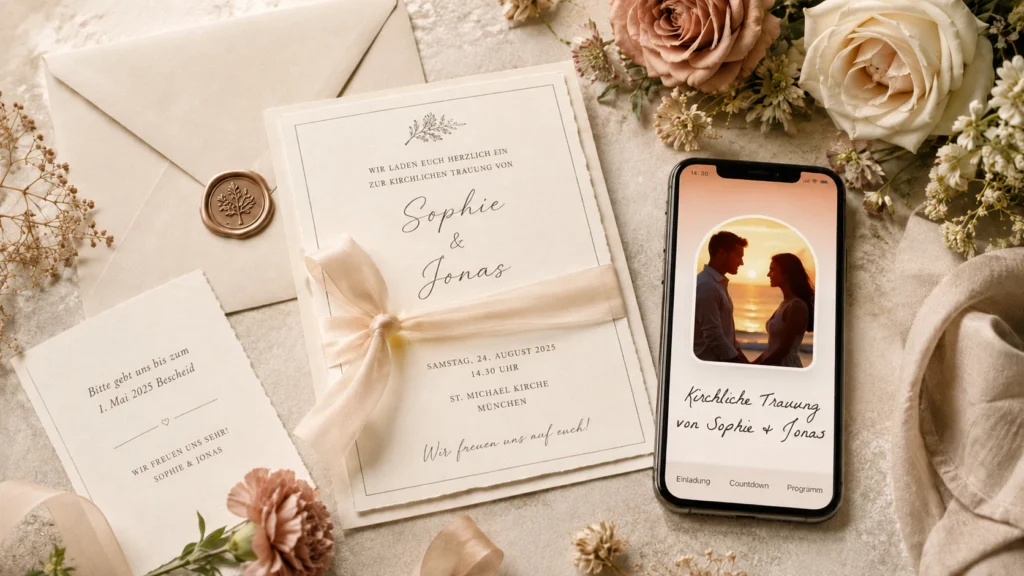
How can stylish wedding stationery and practical digital solutions be combined in a meaningful way? In this guest post, Simply-Wedding explains which information belongs on the classic wedding invitation, when a wedding website is the better choice, and how the two can work together to create a seamless and well-coordinated guest experience.
What belongs on the wedding invitation – and what belongs on the wedding website?
For many guests, the wedding invitation is the first tangible impression of your celebration. The paper, typography, colours and small details already give a sense of whether your wedding will be classic, modern, romantic or intentionally minimalist. At the same time, there is often a lot of information that is difficult to present elegantly on a printed card.
This is exactly where a wedding website complements your stationery: not as a replacement, but as a practical extension for everything that needs more detail, can be interactive or may still change during the planning process.
By combining both thoughtfully, you can create guest communication that is stylish while remaining simple and convenient. The invitation stays the special, personal piece of stationery, while the wedding website helps wherever a printed card naturally reaches its limits.
Why does the classic wedding invitation remain so special?
A printed wedding invitation has a quality that is difficult to recreate digitally. It arrives in the post, is opened with intention and is often kept for a long time. High-quality paper, an elegant format, a special envelope or a wax seal can turn the key details of your wedding into a small keepsake.
That is exactly why the invitation should not be overloaded with as much information as possible. Its strength is not in answering every organisational question. Instead, it can set the mood, build anticipation and reflect your personal style. When planning your wedding, you can therefore use your stationery very deliberately as the creative introduction to your celebration.
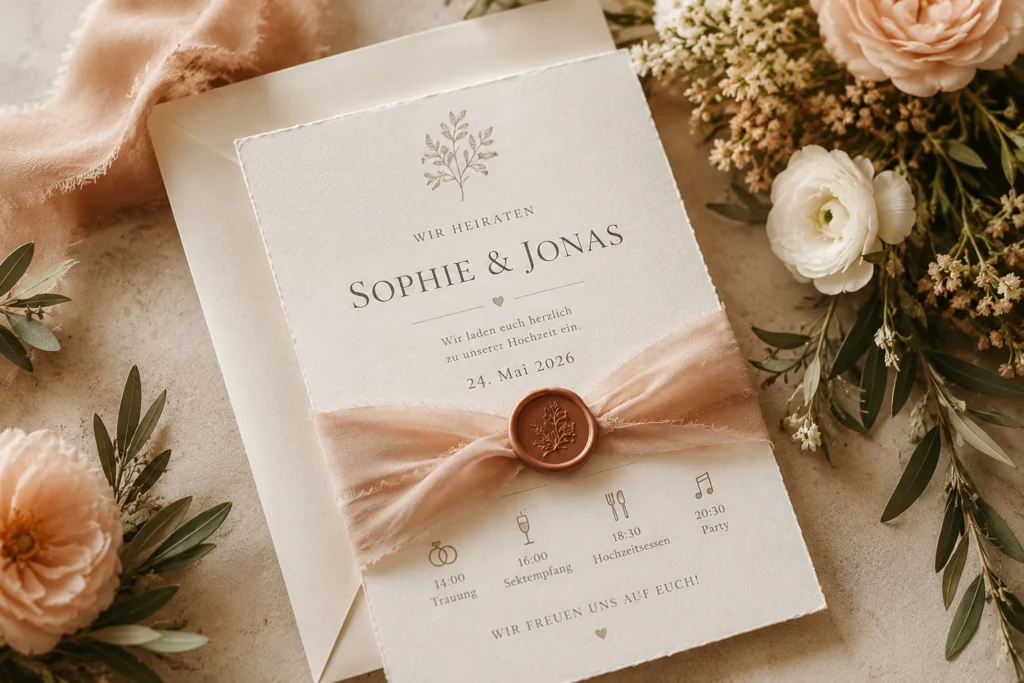
What information should definitely be included on a printed wedding invitation?
Your wedding invitation should primarily include the details that every guest needs to understand at a glance. These include your names, the wedding date, the start time and the main venue or ceremony location. It can also be helpful to mention the general type of ceremony, for example a civil, religious or symbolic ceremony.
A clear RSVP deadline is equally important. Even if guests can accept or decline online via your wedding website, they should be able to see directly on the invitation by when you need their response. The abbreviation RSVP is often used for this. It comes from the French phrase “Répondez s’il vous plaît” and essentially means “Please respond”.
Other details do not necessarily need to appear on the invitation itself. A short reference to your wedding website or a QR code on the wedding invitation is often enough to direct guests to additional information. This keeps the design elegant and uncluttered without leaving out anything important from an organisational point of view.
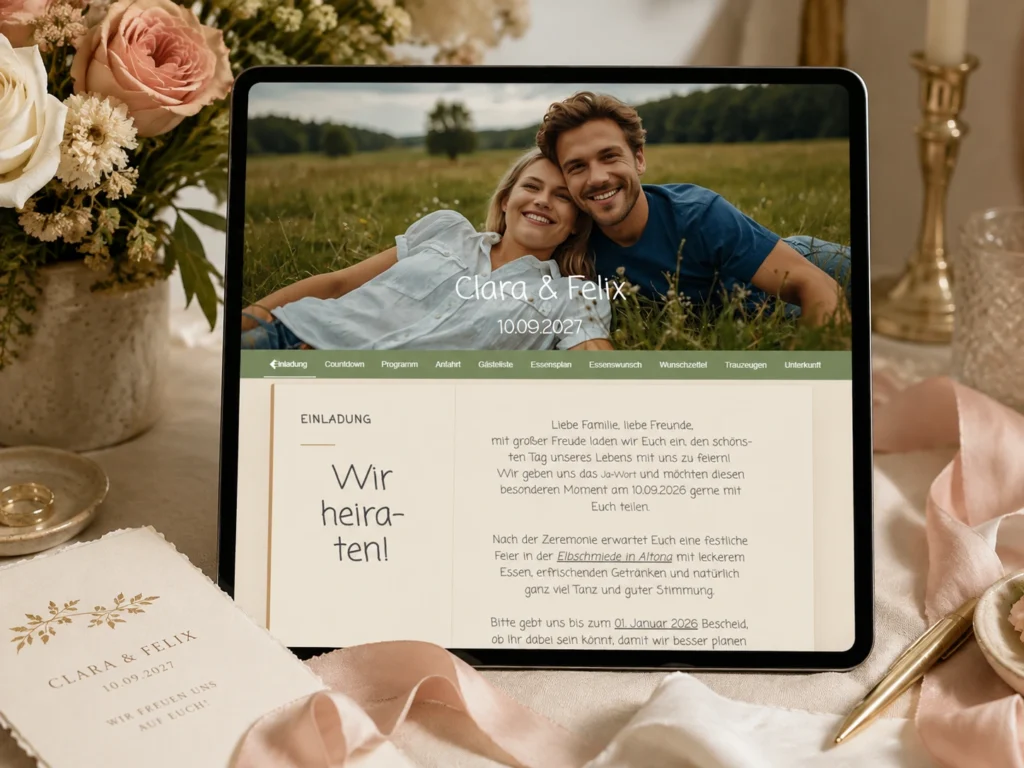
What information is better suited to a wedding website?
A wedding website is particularly useful for anything that needs more space or may still change during the planning process. This can include a full schedule for the day with several programme points and locations. Directions, parking information, accommodation options or shuttle services can also be presented much more clearly online than on a printed card.
The same applies to the dress code. A short phrase may be enough on the invitation, while your wedding website gives you the opportunity to explain what you have in mind, which shoes may be suitable for the venue or whether guests should bring a jacket for the evening.
It is also practical to include sections for contact persons, witnesses, frequently asked questions and gift preferences. If you would like to make your wedding more personal, you can also add photos, the story of how you met or small insights into the planning process.
The biggest advantage: If a time, direction or other organisational detail changes, there is no need to reprint anything. You can simply update the information exactly where your guests will already be checking for the latest details.
How does a wedding website make it easier to manage guest responses?
Guest responses are one of those organisational tasks that can quickly become confusing. One guest accepts via messenger, another declines by phone, someone sends a question by email – and somewhere in between, there is also the information that one guest would like a vegetarian meal.
An online RSVP brings all of this information together in one place. Depending on how it is set up, guests can not only accept or decline, but also specify the number of people attending, dietary preferences and other important details. This gives you a much clearer overview.
A clearly communicated RSVP deadline is still important. The digital option does not replace the deadline itself, but it makes it easier for guests to respond directly. Especially for larger celebrations, this form of guest communication can significantly reduce the amount of coordination required.
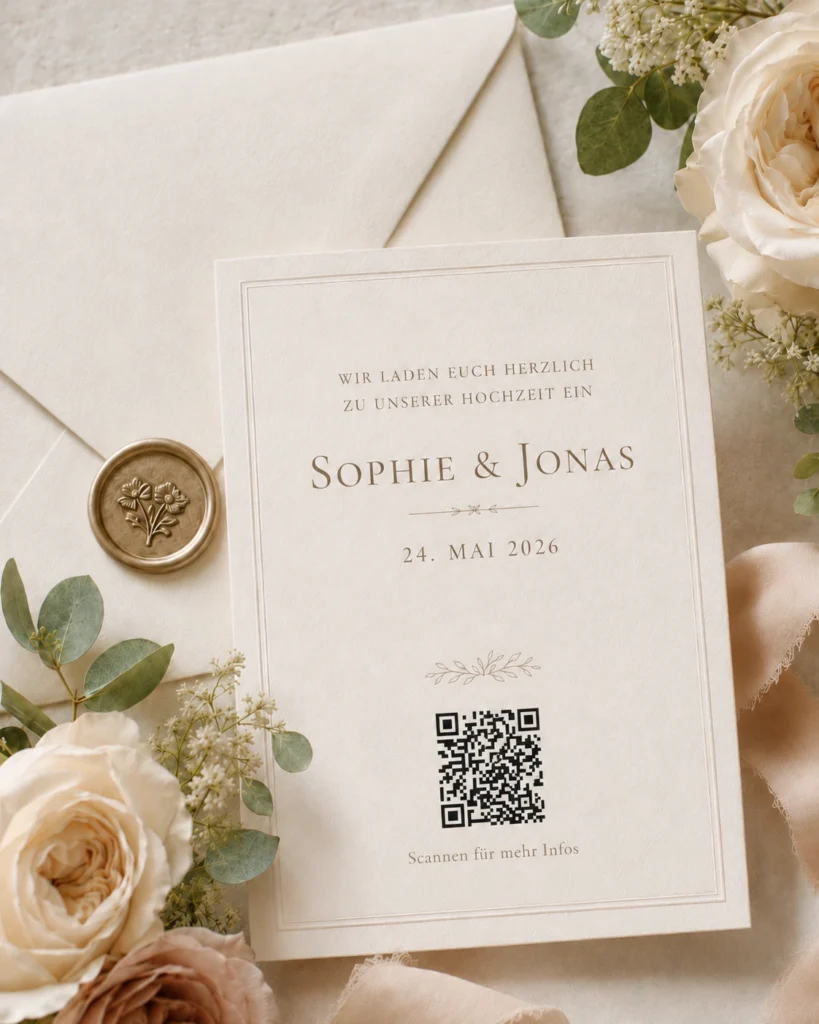
How can wedding stationery and a wedding website be combined in a stylish way?
The transition between your invitation and your website should feel just as seamless as the rest of your stationery concept. One of the easiest ways to achieve this is with a short web address or a QR code. This can be placed on the back of the invitation, on a small insert card or within a dedicated information section.
From a design perspective, a QR code does not have to look out of place. If the colours, typography and spacing match the overall stationery design, it can be integrated in a subtle and elegant way. What matters most is adding a short explanatory sentence next to it. Without context, guests may otherwise be unsure what the QR code leads to.
For example:
“We have put together all the details about the schedule, travel and accommodation for you online.”
“You can find further information and submit your RSVP on our wedding website.”
“Scan the QR code for the latest information about our wedding day and to RSVP.”
This way, the invitation remains elegant while all additional information is only one scan away.
Are older or less tech-savvy guests excluded?
Not if the wedding website is intended as an addition rather than a replacement. The most important details should still appear on the printed invitation, so every guest knows when and where the wedding will take place, regardless of whether they use a smartphone or have internet access.
For RSVPs, you can also offer an alternative option, such as responding by phone. Simple navigation, easy-to-read font sizes and clear labels also help make digital information as accessible as possible.
And if individual guests need a little support, family members or witnesses can help. A digital wedding invitation or website therefore does not have to be mandatory. Instead, it can simply provide an additional convenient option without replacing traditional forms of communication.
When should the wedding website be published?
You do not need to wait until every detail of your wedding has been finalised. As soon as the date and the first key details are confirmed, the website can already be used as a save-the-date or as a central source of information. Additional content can easily be added later.
This is particularly useful if accommodation needs to be booked early or if you would like to share initial information with your guests before sending the official invitation. As the planning progresses, you can then add the schedule, locations, FAQs and RSVP options.
The most important thing is to keep the website up to date throughout the planning process. Once you have set an RSVP deadline, it should be clearly visible both on the invitation and online.
What mistakes should couples avoid?
A common mistake is trying to include every piece of information on the printed invitation. Even beautiful stationery can quickly feel cluttered as a result. At the same time, however, not everything should be moved exclusively to the wedding website.
You should also avoid QR codes without any explanation, very long or difficult-to-read web addresses, and navigation that makes guests search for important information. Check regularly whether times, addresses and contact details are still up to date.
It is also worth paying close attention to privacy. Not every personal detail needs to be publicly visible. Consider which information is intended for everyone and which content you may prefer to make accessible only to your invited guests.
How can Simply-Wedding support this combination in practice?
Couples who want to combine traditional stationery with digital guest communication can, for example, create a free wedding website with Simply-Wedding. This provides one central place for all the important information surrounding the wedding.
Features can include a digital invitation and save-the-date, the schedule for the day, venues and directions, accommodation information and an FAQ section. A guest list and online RSVPs can also be integrated, along with additional options such as collecting meal preferences or music requests.
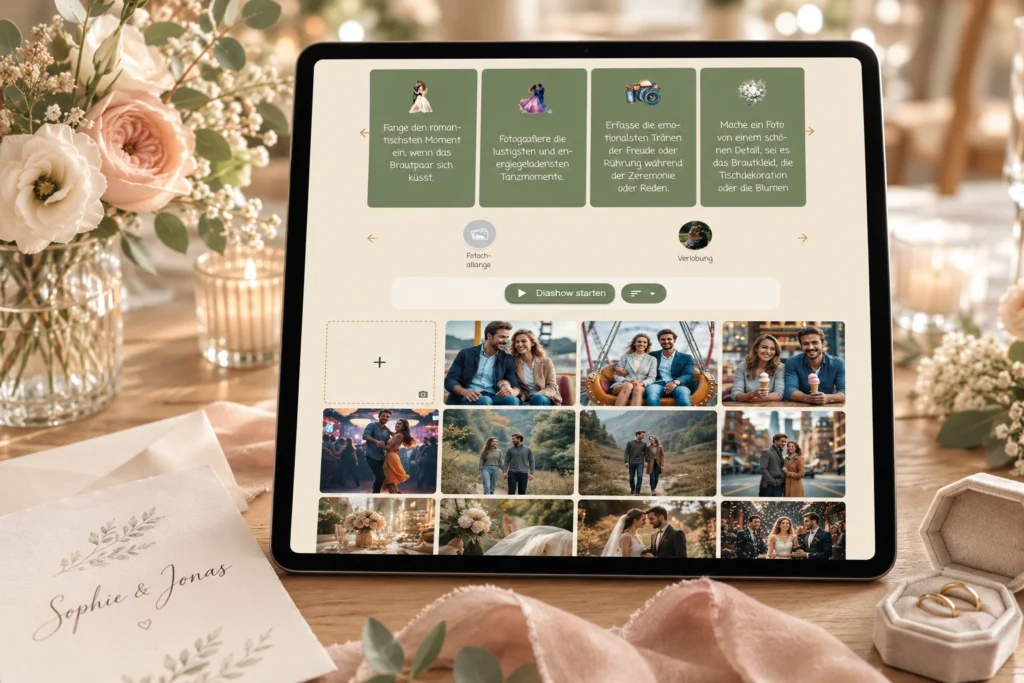
For more personal content, couples can also use features such as a guestbook and photo gallery. QR codes make it easy to share the website with guests via printed stationery or other materials. The basic version is available free of charge.
The idea is not to replace the printed invitation. Instead, it becomes a digital companion that can provide additional information and be updated whenever necessary.
Which combination is right for which couple?
Whether you choose exclusively traditional stationery, rely more heavily on digital solutions or combine both depends on your wedding and your guests. There is no one-size-fits-all approach.
A printed wedding invitation stands out through its tactile quality, personal touch and emotional impact. A wedding website, on the other hand, is particularly useful when information becomes more extensive, interactive or subject to change. For many couples, combining both is therefore the ideal solution: the invitation creates a stylish first impression, while the website serves as a practical companion for all organisational details.
When planning your wedding, it can therefore be helpful not to ask first, “paper or digital?”, but instead:
Which information belongs where so that it looks beautiful, is easy to find and feels right for us?
This approach creates guest communication that is not only easy to manage, but also feels like a cohesive part of your overall wedding concept.
Would you like to complement your wedding invitation with a stylish digital solution?
With Simply-Wedding, you can create your own wedding website and bring all the important information for your guests together in one clear and convenient place.
From the schedule and locations to RSVPs, FAQs, a photo gallery and other personal content, your wedding website can support you throughout the planning process and beyond.
Are you planning your wedding and looking for support with the organisation, design or coordination?
At White Signature Moments, I support you individually on your journey towards a wedding that truly reflects who you are.
I am also always open to new collaborations, styled shoots and creative projects with fellow wedding professionals. If you can imagine working together, I would love to get to know you.
"Where your story becomes a signature moment." ✨
Für die Erstellung und redaktionelle Aufbereitung dieses Beitrags wurden teilweise KI-gestützte Tools verwendet. Die Inhalte wurden anschließend geprüft, überarbeitet und redaktionell freigegeben.